
A physics sandbox vehicle building game gives you something more interesting than a right-or-wrong answer: a machine that shows you why an idea worked. In GravityLab, you assemble the available parts, run the design, and watch how movement and balance affect the result.
GravityLab: Physics Sandbox is available on Android through RivetSoft's official Google Play listing. Its puzzles suit players who enjoy building, observing, and changing an idea rather than selecting a predefined solution. Here is a useful way to approach the first few attempts.
Read the goal before adding parts
Start with the level's actual objective and the parts available to you. A complicated design is not automatically a useful one. Ask what the machine needs to accomplish, then build the simplest version that might do it.
You are looking for a design you can understand when it moves. If the first version has too many mechanisms at once, a failure can be difficult to explain. A simpler starting point gives you a clearer comparison when you change something later.
For an engineering puzzle game on Android, that build-test-observe cycle is part of the fun. The machine itself becomes the feedback.
Watch the whole attempt
When you run the design, pay attention to more than whether it reaches the goal. Where does it begin to struggle? Does it tip, stop, overshoot, or move in a way you did not expect?
The product focuses on how weight, balance, momentum, and the arrangement of parts affect behavior. Use what you can see in the game to decide what to try next. You do not need to turn every attempt into a technical calculation; noticing one clear change is enough to make the next test meaningful.
If the result surprises you, try to identify the first point where the motion differed from your expectation. That can be more informative than looking only at the final resting place.
Change one thing you can evaluate
After an unsuccessful attempt, it is tempting to rebuild everything. Instead, try changing one feature of the arrangement and run it again. You might simplify the construction, reposition a part, or choose a different available mechanism that better fits the obstacle.
The exact options depend on the level and current release. The general habit is to connect the adjustment with the result you observe. If the change helps, keep the useful part. If it makes the behavior worse, you have still learned something about that design.
This is why a vehicle building physics puzzle can remain interesting through repeated attempts. Failure provides information when you can see what changed.
Keep a simple baseline in mind
Before making a large revision, remember what the earlier design did well. Maybe it stayed balanced but lacked the movement needed for the goal. Maybe it moved effectively but became unstable at a particular point.
A baseline helps you preserve the useful behavior while working on the weak part. You do not have to keep adding complexity to make progress. Sometimes the next useful experiment is removing an unnecessary element.
GravityLab's appeal is the ability to explore more than one approach. A solution you understand can be more satisfying than a complicated construction you cannot explain.
Choose it for experimentation
If you enjoy quick reflex competition, a head-to-head game may be a better fit for that session. GravityLab is for the moment when you want to look at a machine, make a change, and see what happens.
Our Scorched Divide guide covers a different kind of decision-making under real-time pressure. If you prefer angle-based puzzles with one clear shot, explore 1 Shot Mini Golf. Each game asks you to observe a result, but the pace and tools are different.
A first-session checklist
- Identify the level's goal and available parts.
- Build a simple machine that addresses the main challenge.
- Run it and watch where the attempt changes direction or stops working.
- Make one deliberate revision.
- Compare the next result with the first.
- Keep experimenting with the parts the level provides.
Frequently asked questions
Can I play GravityLab in the browser on its product page?
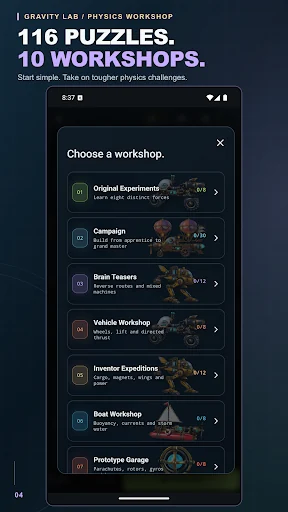
The current GravityLab page introduces the Android game and shows its official artwork and screenshots. Use Google Play to install the game.
What makes it a physics sandbox?
You assemble and test objects whose movement affects the solution. The challenge is about how a design behaves, not just selecting an answer from a list.
Where can I check the current release?
GravityLab: Physics Sandbox on Google Play is the reference for current availability, release information, and purchase details. Download it, begin with a simple machine, and let the first test tell you what to try next.