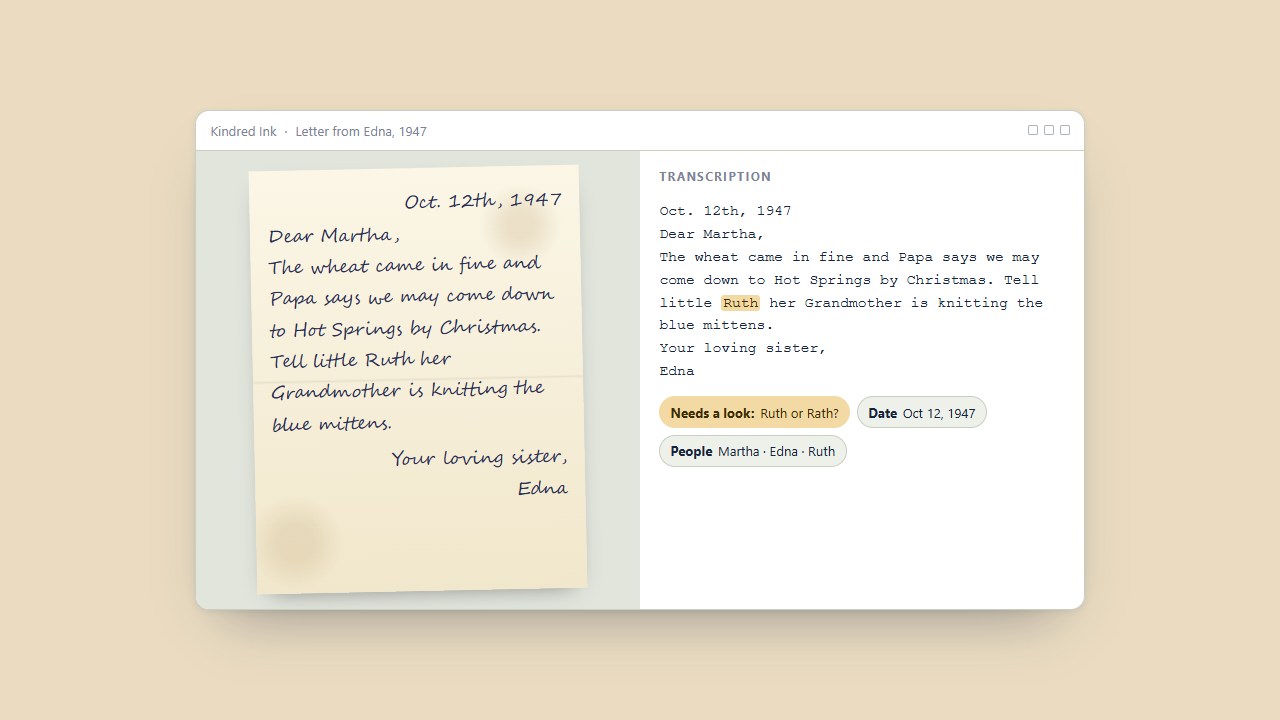
To organize scanned family letters by sender and date, make one record for each letter and keep its pages and envelope together. Record the sender as written, preserve the date you can verify, and mark uncertain details in a note. Use a stable ID to connect the scanned files, transcription, and corrections. That gives you a timeline you can improve later without losing the evidence you started with.
Sort letters into records before naming the files
Lay out one letter and its associated items. Include both sides of a page when they contain writing, and keep any envelope or insert you can confidently match to it. If you found several loose pages together, check page numbers, folds, dates, and whether the text continues. Record when you're uncertain. An intended sequence is much easier to correct when you know which parts came from a guess.
Give each letter a stable ID
A simple ID like FK-0042 can stay with the record even if you later correct the sender or date. File names such as FK-0042-page-01 and FK-0042-envelope make the pieces easy to find. Give yourself enough digits for the collection you're working on. If two letters arrived on the same date, their separate IDs still distinguish them, even if the first version of your timeline groups them together.
Keep the written name and your normalized name
Your record can show what appears in the letter and a consistent name for sorting. If a sender signs “Aunt Vi” and you have confirmed that this is Violet Carter, keep both forms. Then searches for either one can help you find the letter. If two relatives used the same nickname, describe what evidence helped you tell them apart and leave ambiguous cases open until you have more information.
Don't assume the addressee and recipient are always identical. A letter can be forwarded, shared, or kept with papers owned by someone other than the person it addresses. If you know where the letter was found, add that context as a separate field or note. That detail can matter when someone in the family asks how a grouping was created.
Separate the date on the letter from the postmark
If the letter says November 4 and the envelope is postmarked November 6, record both as distinct facts. When only the month or year is readable, label that precision. Write something like “November 1948, day unclear” in your notes. You can sort by an approximate date when that serves your project, but keep the original evidence and the uncertainty clear to a later reader.
Make a small index you can search
For a first pass, use columns for ID, sender, recipient, date written, place, and a short description. A note can include uncertain readings, the letter's physical location, and the basis for a correction. Choose two or three tags you will actually use, such as school, wartime correspondence, or farm. Tags are useful when a cousin remembers an event but can't remember who wrote about it.
Add transcriptions gradually. Work from a copy and keep the original scan easy to open beside the text. An unfamiliar town name or older surname may be worth checking against another document. The handwritten letter transcription guide explains how to read difficult words while preserving your uncertainties. If you correct something later, record what changed and why, especially if other family members already have an earlier copy.
Start with one correspondent or one year
Before you share the first group, ask a relative to find a letter using your index without your help. Notice whether they search for a nickname, a town, or the person who received it. Their search gives you a practical way to choose the next tag or alternative spelling to add.
Pick enough letters to see a pattern, then try finding three items using your new index. Look for a known sender, an approximate date, and a topic that spans several letters. If one search fails, check whether you need an alternative spelling, a clearer date note, or a better tag. Use what you learn before you process the rest of the collection.
Kindred Ink brings scanned documents, search, tags, and transcriptions into a private family library on your computer. If you prefer to start in folders, apply the same record IDs and naming choices there. Try the workflow on one small bundle first. The goal is to find and understand a letter six months from now, even if someone else did the scanning.